There's a real appeal to building your site on Wix or Squarespace or WordPress.com. You pick a template, drag a few things around, type in your hours and your phone number, and you're live by the weekend. No developer. No invoice with four digits on it. For a lot of small businesses that's a fair trade, and I'm not going to pretend it isn't.
But there's a question most people never ask before they sign up, and it's the one that matters most a few years down the road: when you stop paying, what do you actually have?
On most of those platforms, the honest answer is nothing you can take with you. The site lives on their servers, built out of their proprietary blocks, tied to your subscription. Stop paying and it goes dark. You can't export it and host it somewhere else. You can't hand the files to another developer and say "pick up where this left off." There are no files in any real sense — there's an account, and the account *is* the site.
That's not a website you own. That's a website you rent.
The rent is the part that sneaks up on you.
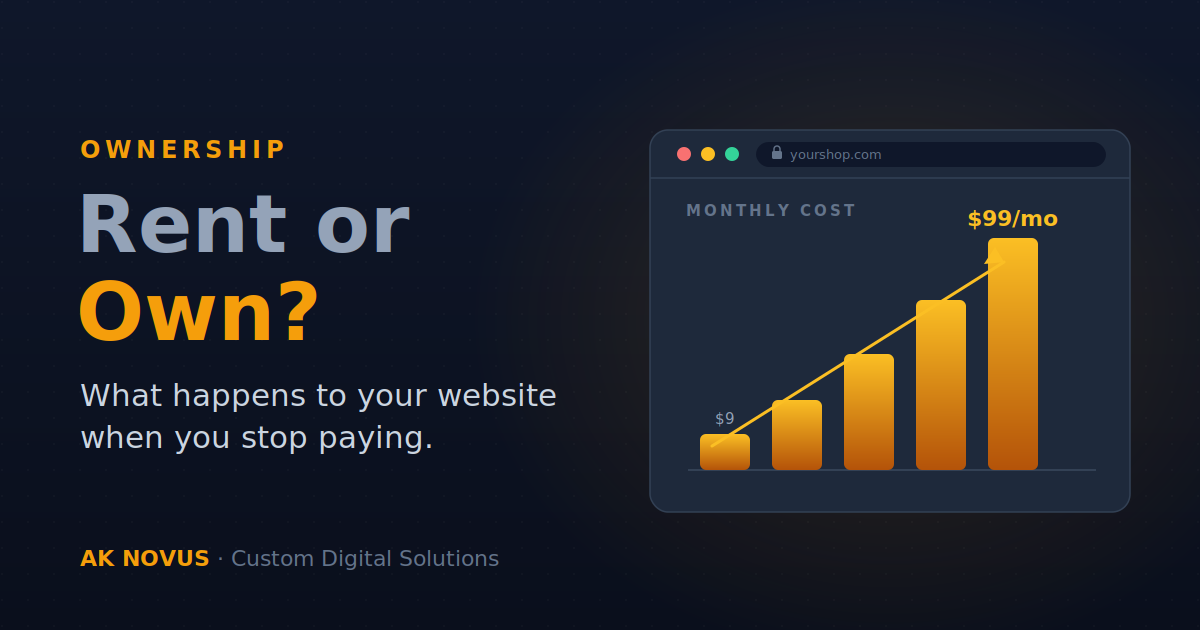
You start on the cheap plan. Then you need the one that removes their ads, or connects a custom domain, or unlocks online booking, or gives you more than the handful of pages the starter tier allows. Each jump is small. Stack a couple of paid plugins or apps on top — a form builder here, an SEO add-on there — and the monthly number keeps climbing. You pay it every month, and at the end of five years you've spent real money and still own nothing.
A custom build flips that math. It costs more upfront — for what I do, anywhere from $1,750 to $25,000-plus depending on what the project actually needs. No getting around that being a bigger number on day one. But what you get for it is the thing itself. The code is yours. The files are yours. You can host it where you want, move it when you want, and if you ever stop working with me, you can hand the whole project to another developer and they can keep building on it. Nobody else holding the keys.
Ownership also means the site can become more than a site. When it's built on a real foundation — React on the front, Node and PostgreSQL behind it — there's somewhere to grow into:
A page builder can't get you there; it was never meant to. A custom build can, because you own the whole stack and nothing's locked behind someone else's plan tier.
None of this means a template is the wrong call for everybody. If you need a simple page that lists your hours and your phone number and you're never going to need more than that, rent the template and don't think twice. That's a fine use of a few dollars a month.
But if you're building something you expect to still be running in five years — something you want to grow, move, and actually own — it's worth knowing the difference before you pick. One of these you keep. The other one you're just borrowing.