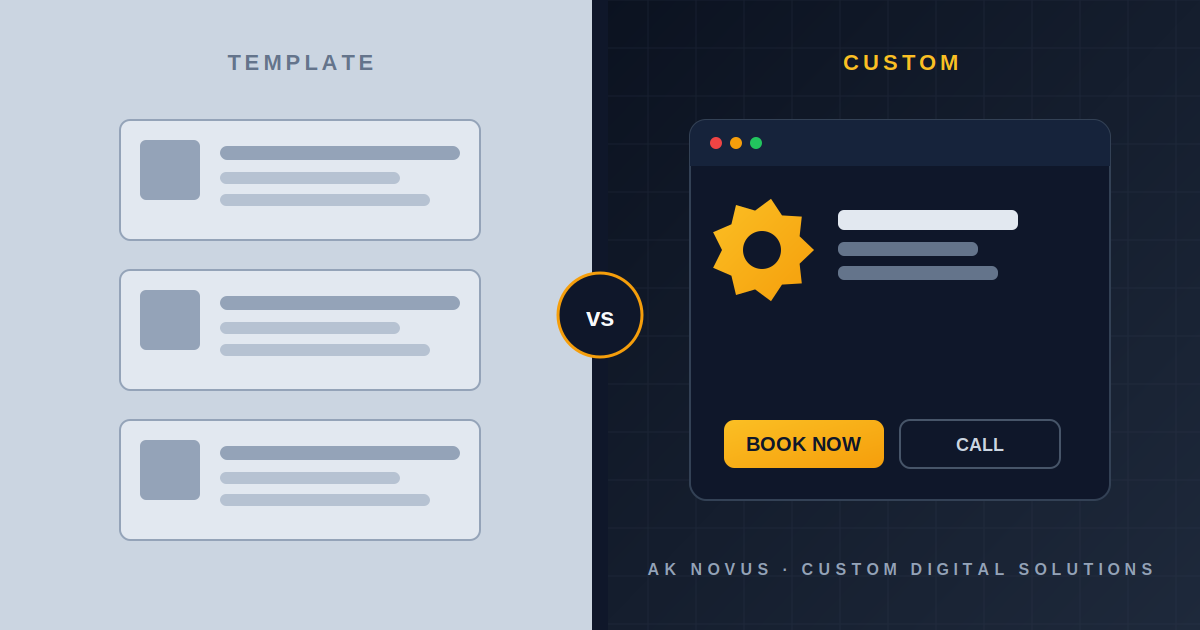
I've built websites for auto shops. Heritage Auto Care, Lobo Automotive — real shops, custom-coded from the ground up. So when I lay out template versus custom, it's not a sales pitch. I've done both sides of it.
Let me start with the honest part, because it matters.
If all you need is a digital business card — name, phone, hours, a photo of the bay — a template is fine. Wix or Squarespace will get you online for thirty bucks a month, and for a one-man shop that just needs to show up in a search, that's a reasonable call. I'm not going to talk you into spending money you don't need to spend.
But that's not most shops. Most shops want the site to do something — pull in jobs, take a booking, hold up when work gets busy. That's where a template quietly starts costing you more than it saves.
Here's what I see push shops toward a custom build.
Speed. A template site carries a lot of weight it didn't ask for — the page builder, the plugins, scripts running in the background. That weight shows up as load time, and on a phone, a slow site loses people before they've read a word. A lean build is fast because there's nothing in it that doesn't need to be there.
The phone is the whole game. Somebody's broken down on the shoulder searching "brake repair near me." If your site is hard to read or the call button's buried, the job goes to the shop whose number they could actually tap. Custom means it's built for the phone first, not shrunk down from a desktop layout as an afterthought.
SEO you control. Templates give you the SEO tools the platform decides to hand you, and that's the ceiling. With custom code you handle the technical side properly — service-area schema, clean markup, the structure that helps you land in the Google Maps results.
Booking on your own site. Instead of bolting on a $99-a-month scheduling add-on and shipping your customer off to a third party, a real backend lets them pick a service and a time right there on your site. Their information stays yours.
Fewer doors to break down. The chronic problem with template platforms is the plugin pile — every plugin is one more door somebody could walk through. Fewer moving parts means fewer doors.
Room to grow. This is the one I care about most. A template is a website, and that's where it stops. A custom build sits on a real backend — Node, PostgreSQL — so when you're ready for a customer portal, text reminders, online parts ordering, it's an addition, not a teardown. The site grows with the shop instead of slamming into a wall.
And when three shops in town all run the same template, they all look like the same shop. Yours wouldn't.
None of this makes custom the right answer for everybody. If you just need to exist online, save your money — I'll tell you that to your face. But if the website's supposed to earn its keep, and for most shops it is, you want it built for the work by somebody who's done the work.
That part I can speak to. I've turned wrenches. I've built the sites. I know which corners actually matter and which ones don't.
If your current site is slow, or you've outgrown it, send me a message. I'll look at what you've got and tell you straight what a custom build would — and wouldn't — do for your shop. No charge to find out.